
⚠️ Ford has already revised the EcoBlue service interval — has yours been updated?
Ford shortened the 2.0 EcoBlue timing belt interval from the original 10 years/240,000km to 6 years/100,000 miles. Many Transit and Transit Custom owners are unaware of this change. If your van is approaching or past either limit — or if you don't have full service history — call us now on 07518 605191.
The Ford Transit is Britain's best-selling van, and the 2.0-litre EcoBlue diesel — Ford's codename for it is Panther — has powered the Transit and Transit Custom since 2016. It's a capable, efficient engine that has genuinely transformed the Transit's appeal. But it has a timing system that many owners and even some mechanics don't fully understand, and the consequences of getting it wrong are severe.
This guide corrects some common misconceptions and gives Transit owners the accurate picture they need.
The EcoBlue Is a Wet Belt Engine — Not a Dry Belt
One of the most important things to understand about the 2.0 EcoBlue Panther is that it does not use a conventional external dry timing belt. It uses a belt-in-oil (BIO) wet belt system — the same fundamental design that has caused widespread problems with the Stellantis PureTech.
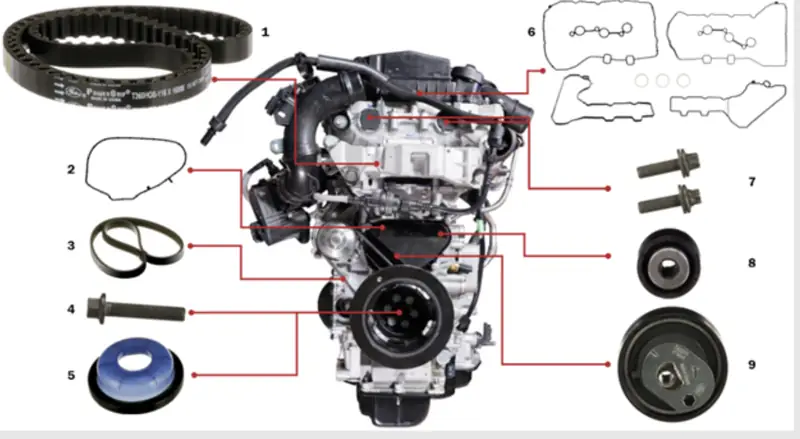
In fact, the EcoBlue goes further than most: it has two belts, both running submerged in engine oil:
- The timing camshaft belt — controls the relationship between the crankshaft and camshafts, keeping valve timing precise
- The oil pump drive belt — drives the engine's oil pump, which is belt-driven rather than chain or gear-driven on this engine
Both belts run in oil. Both must be replaced together. Replacing one without the other is a false economy — the labour to access the timing system is the same, and a failed oil pump belt will immediately destroy the new timing belt and starve the engine of oil pressure.
Why Ford Shortened the EcoBlue Belt Interval
Ford originally published a generous service interval for the EcoBlue timing belt: 10 years or 240,000km (150,000 miles). That interval has since been formally revised downwards to 6 years or 100,000 miles (160,000km) — whichever comes first.
The reason for this revision is specific and technically important: DPF regeneration causes oil dilution.
Modern diesel engines like the EcoBlue use a Diesel Particulate Filter (DPF) to trap soot from exhaust gases. Periodically, the DPF must regenerate — it runs a high-temperature cycle that burns off the accumulated soot. During certain regeneration cycles, small quantities of fuel enter the engine oil through the cylinder walls and past the piston rings. Over time, this fuel dilutes the oil.
Diluted oil has lower viscosity, reduced lubricating properties, and crucially — it attacks the polymer compound of the wet timing belt at an accelerated rate. Ford's original interval was calculated on the assumption of clean, undiluted oil. The reality of real-world DPF regeneration means the oil degrades faster than laboratory models predicted.
Ford issued a Technical Service Bulletin identifying that vehicles "may be affected by premature wear and delamination of the timing belt" as a direct result of this oil dilution. The revised 6-year/100,000-mile interval is the response.
💡 Short journeys make this worse
DPF regeneration requires sustained higher-speed driving to complete. Vans used predominantly for short urban journeys — deliveries, local trades — often never complete a full regeneration cycle. The DPF clogs more frequently, attempted regenerations fail to complete, and fuel contamination of the oil is significantly higher. If your Transit does a lot of town work, the belt is under more stress than the mileage alone suggests.
What Happens When an EcoBlue Wet Belt Fails
The Panther engine is an interference engine. This means that when the timing belt breaks or skips teeth, there is no separation between the space occupied by the pistons at top-dead-centre and the space occupied by the open valves. The result is immediate and catastrophic:
- Valves are bent or snapped
- Pistons are damaged or cracked at the crown
- Cylinder head damage is almost certain
- In severe cases, connecting rods or the block itself can be damaged
For a working van, this means being stranded on the road with a vehicle that is frequently uneconomical to repair. Replacement engines are available, but the labour and parts cost on a Transit can run to £4,000–£7,000 or more. For vans with higher mileage, this frequently exceeds the vehicle's value.
The oil pump belt adds another failure mode. If the oil pump belt fails first — quietly, without snapping the timing belt — the engine loses oil pressure immediately. Oil starvation causes bearing failure, camshaft damage, and potential seizure, often before the driver has time to react to the warning light.
Our EcoBlue Wet Belt Replacement Service
At City Auto Works, we carry out Ford Transit and Transit Custom 2.0 EcoBlue wet belt replacements using genuine OE Ford parts throughout — including the timing belt kit and Ford specification Castrol oil. Using the correct oil grade is not optional on this engine. Ford's latest specification oil contains additives specifically formulated to minimise the chemical attack on the wet belt material. Cutting corners on oil spec accelerates the very degradation you're paying to prevent.
Our full replacement service includes:
- Genuine OE Ford timing camshaft wet belt
- Genuine OE Ford oil pump drive wet belt
- Belt tensioner and idler pulleys
- Timing belt cover and gasket
- Sump pan replacement (where required)
- Full oil and filter change using Ford specification Castrol oil
- Post-replacement inspection and documentation
We are mobile — we come to your home, yard or workplace across Milton Keynes and a 15-mile radius. A full EcoBlue wet belt service typically takes 4–5 hours. We bring everything needed; you don't need to source parts or arrange transport to a garage.
Pricing from £950 including VAT. Call 07518 605191 for a fixed price on your specific vehicle and specification.
Why Genuine OE Ford Parts Matter Here
The EcoBlue wet belt replacement is not a job where aftermarket parts are a sensible cost-saving. Here's why:
- Belt material specification: The OE Ford belt is manufactured to the exact polymer compound specified for this oil chemistry environment. Aftermarket belts may not meet the same standard, and failures have been documented with non-OE belts fitted to EcoBlue engines.
- Oil compatibility: Ford's revised service guidance specifies particular oil grades. Generic oils or incorrect specifications will degrade the new belt prematurely, shortening the interval and creating liability for any subsequent failure.
- Tensioner and pulley tolerances: The OE components are manufactured to the precise tolerances required for the dual belt system. Aftermarket pulleys with slightly different dimensions can cause belt tracking problems.
We don't offer a budget version of this service because there isn't a responsible one. OE parts and correct oil specification are non-negotiable for an engine that can destroy itself if the belt fails.
Warning Signs on the EcoBlue
Because the belts are submerged in oil inside the engine, there are limited external clues. However, watch for:
- Oil warning light or low oil pressure: A failing oil pump belt will reduce oil pressure — do not continue driving if this light appears
- Rattling or ticking on cold start: Belt slap in the timing housing, often dismissed as normal cold-start behaviour
- Rough idle or misfires: Timing drift from a worn or stretched belt causes combustion irregularities
- Fault codes P0340, P0341, P0335, P0336: Camshaft or crankshaft position sensor errors often indicate timing is off
- Smoky exhaust and increased oil consumption: Signs that the oil is being contaminated and the DPF regeneration cycle is failing to complete
- Mileage and age: If you're approaching 100,000 miles or 6 years from new — or if you have no record of a previous belt change — treat it as due now
⚠️ Second-hand Transits — check the history carefully
When buying a used Transit EcoBlue, always verify timing belt history in the service records. Many sellers — and even dealerships — are unaware that Ford revised the interval, meaning vans are being sold with belts that appear "within interval" by the old schedule but are already overdue by the current one. If in doubt, factor in the cost of immediate replacement.
Why Mobile Replacement Makes Sense for Van Operators
Your van is your livelihood. Leaving it at a garage for a day costs you time, money and potentially work. We eliminate that problem by coming to you — your drive, your yard, your workplace car park. You're free to carry on with other tasks while we work. No courtesy vehicle needed, no disruption to your working day.
We cover Milton Keynes, Wolverton, Bletchley, Newport Pagnell, Buckingham, Towcester, Olney, Leighton Buzzard, Woburn and all areas within 15 miles of MK. Call or WhatsApp us to check your postcode and arrange a convenient time.
Ford Transit EcoBlue Wet Belt Replacement — From £950
Genuine OE Ford parts. Ford spec Castrol oil. Mobile service — we come to you. Milton Keynes and 15-mile radius. Fixed price, no surprises.
Frequently Asked Questions
Does the Ford Transit EcoBlue have a wet belt or a dry belt?
It's a wet belt (belt-in-oil) system. The 2.0 EcoBlue Panther engine has two belts that both run submerged in engine oil: a timing camshaft belt and an oil pump drive belt. Both must be replaced at the same time.
Why did Ford shorten the EcoBlue timing belt service interval?
Ford's original interval was 10 years or 240,000km. It was revised to 6 years or 100,000 miles after evidence emerged that DPF regeneration cycles cause fuel to contaminate the engine oil, which then degrades the wet belt material faster than anticipated. Ford issued a Technical Service Bulletin identifying premature belt wear and delamination on affected vehicles.
What oil should I use in a Ford Transit EcoBlue?
The EcoBlue requires Ford-specification oil — typically a 0W-20 grade meeting Ford's WSS-M2C952-A or equivalent current specification. We use Ford specification Castrol oil on every EcoBlue service. Using an incorrect grade or a non-Ford-approved oil will accelerate belt degradation and may invalidate any warranty claim.
Can I replace just one of the two EcoBlue belts?
No. The timing camshaft belt and the oil pump drive belt share the same engine housing. Accessing either belt requires the same disassembly. Replacing only one belt means paying the same labour cost again if the other fails — and a failed oil pump belt will immediately destroy a new timing belt and starve the engine of oil. Always replace both together as a full kit.
How long does an EcoBlue wet belt replacement take?
Typically 4–5 hours for a complete dual belt service including oil change. We carry out the work at your location, so there's no time lost travelling to or waiting at a garage.
Is the Ford Transit EcoBlue an interference engine?
Yes. If either timing belt fails on a running engine, the pistons will immediately collide with the open valves. The resulting damage — bent valves, cracked pistons, cylinder head damage — is severe and rarely economical to repair on a high-mileage van.